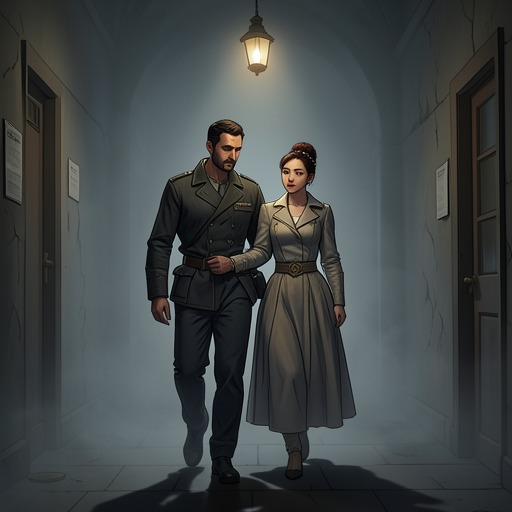
Lu Xun Searches for and Brings Back Su Xiangwan
CEO's Beloved Honey GirlLu Xun Searches for and Brings Back Su Xiangwan is a decisive pursuit sequence because Lu Xun’s response to Su Xiangwan’s disappearance moves through three forms of attachment: frantic searching, institutional control, and intimate reassurance. What begins with his inability to find her in the streets ends at the home of Mo Beiyu, where Lu Xun identifies her as his wife and takes her back even as her fever and exhaustion make the reunion a medical and emotional crisis rather than a simple romantic recovery.
Causes and Background
Su Xiangwan’s disappearance follows a rupture in the marriage that has made home itself feel unsafe. Lu Xun initially treats her absence as a flight from home and searches the streets for three hours, but the crowded city gives him no result. As traffic and pedestrians increase, he realizes that she is not simply outside avoiding him; she is deliberately hiding from him and therefore will not appear in the places where an ordinary search would expect to find her.
The distinction changes the nature of the action. Lu Xun is not pursuing a lost person whose route can be reconstructed from public sightings. He is trying to penetrate a retreat chosen specifically to escape his attention. His lack of knowledge about Su Xiangwan’s friends and habits becomes an immediate weakness. The evidence describes him as having only a poor understanding of her private world, and that limitation makes even his considerable resources insufficient on their own.
Lu Xun’s personal history gives the pursuit an additional psychological charge. He once endured a kidnapping at the age of twelve, during which the kidnappers forced him to take various medicines and he nearly lost his life; afterward, his body became resistant to drugs. He recounts the experience with an unwavering gaze, as though describing someone else, suggesting that the old pain has been distanced rather than erased. Su Xiangwan’s disappearance therefore enters a life already marked by captivity, danger, and the fear of losing control over another person’s fate.
The Search and Its Escalation
After the street search fails, Lu Xun converts his anxiety into an operation. He deploys police resources and orders everyone in his group to spread out and search for Su Xiangwan. The command shocks the people around him because his wife has suddenly vanished, but no one dares to question him, especially Gordon. Lu Xun’s authority makes the search efficient in scale, yet it also reveals the imbalance at its center: Su Xiangwan seeks concealment, while Lu Xun answers concealment with a widening net of surveillance and command.
Gordon reports that the group has investigated the relevant areas without finding any trace of Madame. Lu Xun then asks Su Qingrou for the names of all the friends who might know Su Xiangwan late at night, intending to send people to investigate immediately. This request is both practical and revealing. When direct knowledge fails him, he must reconstruct Su Xiangwan’s emotional and social network through other people, turning intimacy into information that can be gathered, cross-checked, and acted upon.
The search eventually leads to Mo Beiyu’s residence. An urgent knock wakes Liu Xi, who comes out of the guest room and finds four or five policemen at the door, with a noble-looking Lu Xun behind them and still more bodyguards behind him. The police say surveillance shows that someone at the residence rescued a young woman by the roadside two days earlier and ask to enter and confirm whether she is there. The presence of surveillance footage gives the pursuit a technological dimension: Su Xiangwan’s refuge has been located not through her confession but through a chain of observation and institutional investigation.
Mo Beiyu refuses to let the group enter without proper proof, objecting to their sudden arrival and attempted intrusion. Lu Xun then raises his head and states that he has come to fetch his wife, asking whether Mo Beiyu has any objection. The declaration is not merely an identification. It asserts marital status as a claim of authority, placing Lu Xun’s relationship to Su Xiangwan above the protective boundary Mo Beiyu has established around her.
Retrieval and Physical Crisis
Su Xiangwan eventually walks out under the gaze of everyone present. The recovery does not produce a triumphant reunion. Her feet feel as though they are stepping on cotton, her legs are sore and weak, her body burns with fever, and her consciousness is fading. At the elevator, she reaches toward the button but faints before her fingertips can touch it. Her body records what the pursuit has concealed: she is not in a condition to make the return look voluntary, orderly, or emotionally resolved.
Her collapse changes the value of the scene from possession to urgent care. Lu Xun’s anger remains visible in his orders concerning Hua Shuo’s studio, but the immediate reality is that Su Xiangwan cannot simply be escorted home as though the conflict were over. The search has succeeded spatially while failing to restore stability. Lu Xun has found the person he wanted to recover, yet the recovered wife is physically depleted and psychologically overwhelmed.
The pattern of pursuit and collapse echoes other injuries in the relationship. Su Xiangwan has previously been associated with weakness and fever, while Lu Xun’s own history includes kidnapping and drug-related bodily trauma. The sequence places two vulnerable bodies beside one another: one responds to fear by disappearing, and the other responds to disappearance by extending his control. Their reunion therefore carries both care and threat, because the same determination that brings Lu Xun to her refuge also leaves little room for her withdrawal to remain respected.
Marriage, Rivalry, and Reassurance
The retrieval is surrounded by competing definitions of intimacy. Mo Beiyu shelters and cares for Su Xiangwan, while Lu Xun arrives with police and bodyguards to take her back. Their confrontation is not only a contest between two men; it stages two models of protection. Mo Beiyu’s protection is based on concealment and physical refuge, whereas Lu Xun’s operates through authority, surveillance, and the public force of the marital title.
The conflict also intersects with Lu Xun’s rivalry with Chu Fei. Chu Fei tells Lu Xun that he is an eyesore because Chu Fei likes Su Xiangwan, while insisting that he will not force a woman and prefers the process of pursuit. This contrast sharpens Lu Xun’s position. Chu Fei frames desire as a chase, but Lu Xun treats Su Xiangwan as someone already bound to him through marriage. The resulting triangle places pursuit, consent, and possession in uneasy proximity without allowing any of them to remain abstract.
After Su Xiangwan is brought back, fear becomes the immediate language of the household. Lu Xun returns with hot milk and gently urges her to drink it while it is warm. She tells him that she is frightened, and he comforts her by saying that he has been there all along. The gesture is tender, but it is also a continuation of the same pattern that shaped the search: Lu Xun presents himself as the constant presence who can keep danger away, even though his insistence on recovering her helped produce the conditions from which she was fleeing.
Their exchanges repeatedly test whether Su Xiangwan recognizes him as husband rather than merely as one powerful man among many. When Lu Xun asks what their relationship is, she pulls off his shirt and answers flirtatiously that he is her husband. The moment offers a temporary restoration of mutual recognition, yet Lu Xun remains uncertain whether she truly knows who he is. That uncertainty keeps the reunion from becoming uncomplicated reassurance; even a declared marital bond must be tested against fear, confusion, and the presence of other men.
Significance and Aftermath
The search sequence exposes Lu Xun’s central contradiction. He is capable of tenderness, personal sacrifice, and sustained care, but when Su Xiangwan withdraws, he does not initially answer with patience or distance. He searches the city, mobilizes police, commands his organization, interrogates the network of people around her, and arrives at a private residence surrounded by official personnel and bodyguards. His devotion is therefore inseparable from an impulse to reclaim control.
Su Xiangwan’s disappearance briefly reverses the usual arrangement of power. Lu Xun may command companies, police contacts, and bodyguards, but he cannot locate a woman who understands that hiding from him requires vanishing from the obvious world. Her silence becomes an active strategy, and his failure to know her friends proves that legal or marital closeness has not automatically produced emotional knowledge.
The ending does not erase the rupture. Lu Xun succeeds in bringing Su Xiangwan back, but she faints at the elevator, needs comfort, and remains surrounded by the consequences of fear and physical illness. The action consequently functions less as a clean reconciliation than as a temporary closure to separation. It restores proximity while leaving the underlying struggle between freedom and possession unresolved.